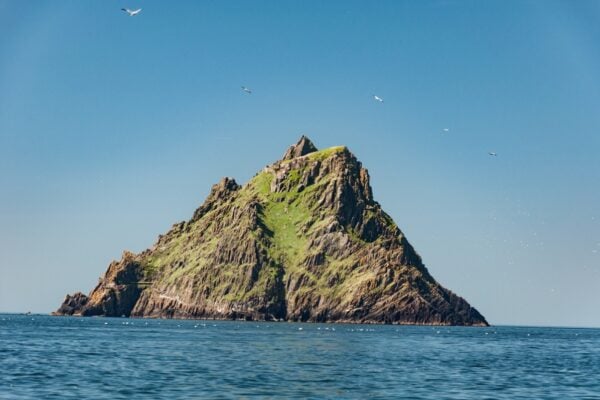
Church, Sceilg Mhichíl, Co. Kerry
Co. Kerry |
Churches & Chapels
At the north-eastern peak of Skellig Michael, one of the larger of two surviving oratories offers something that most early medieval structures cannot: a second life.
The building, which dates from the period of early Christian monasticism on the island, was quietly repurposed in the nineteenth century as a working chapel for lighthouse personnel. The outer face of its corbelled dome appears to have been reconstructed at that time, meaning what visitors see today is partly the work of medieval monks and partly the pragmatic hand of lighthouse keepers seeking somewhere to worship on one of the most remote outposts off the Kerry coast.
The oratory is built entirely of dry sandstone rubble in the corbelled technique, where each course of stone projects slightly inward over the one below until the walls close to form a self-supporting dome, no mortar required. It measures roughly 6.1 metres by 4.25 metres externally, with walls averaging 1.1 metres thick at the base, and rises to a vault approximately 3.25 metres high, sealed with flat flags. Internally the space is considerably smaller, just 3.65 metres by 2.45 metres, lit by a single lintelled window less than half a metre high in the east wall. The west doorway narrows as it rises, a characteristic form in early Irish ecclesiastical buildings, and its threshold is roughly flagged. Outside, above the doorway, quartz stones have been set into the masonry in the shape of a Latin cross, though this is a later insertion and its date remains uncertain. Excavations carried out in 1987, ahead of conservation work on the doorway, revealed traces of charcoal and mortar near the surface, consistent with the lighthouse-era occupation, and beneath that a layer of re-deposited boulder clay that may have been laid down deliberately to raise the floor level during the original construction. A masonry and brick altar once stood against the east wall, a fixture of the lighthouse chapel phase. The antiquarian Crofton Croker, writing in 1838, noted a carved wooden crucifix hanging above it, and a stone water stoup, a small basin for holy water, was recorded on the altar by a later observer in 1903.
Visitor Notes
Added by