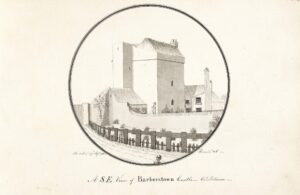
A medieval church ruin that doubles as a family vault, with a fortified tower modified beyond recognition and a nineteenth-century mausoleum grafted onto its side, is not the most straightforward thing to read in a graveyard. The ruins at Oakleypark, known historically as Kildrocht or Kildrought, present exactly this kind of layered confusion, where centuries of alteration have left a structure that is partly medieval, partly domestic monument, and partly a convenient building material for whoever came next.
The site sits on ground traditionally associated with St. Mochua and a probable early Christian monastery, the only surviving hint of which is a faint curving line in the landscape that may trace the boundary of an early ecclesiastical enclosure. The medieval parish church itself is first recorded in the charters of Thomas de Hereford, who granted the church of Kildroch to St. Thomas' Abbey in Dublin. By the taxation of 1302 to 1306, the vicarage was valued at 43 shillings, with one third of the church's income reserved for the support of the vicar, an arrangement that persisted into the sixteenth century. A royal visitation in 1615 found the church and chancel of Kildrought in good repair, which makes its present condition something of a long decline. The nave is likely fourteenth-century in origin, with a fortified tower added at the western end in the fifteenth or sixteenth century, complete with a stair turret at its south-west angle. This tower was later converted into a mausoleum for the Aylmer family, a process that involved removing its original eastern wall entirely and rebuilding it several metres into the nave. The antiquarian Austin Cooper sketched the structure around 1780, recording an entrance in the western wall, three floors over a vault, a parapet with a narrow belfry, and a battlemented stair turret. The tower was subsequently lowered and fitted with modern crenelations, giving it a somewhat incongruous appearance today.
What remains standing is the eastern gable wall, rising to about seven metres, with the jambs and mullion of a large three-light round-headed window still legible despite the loss of its tracery. The foundations of the north and south walls are grassed over but traceable, running to a total length of roughly 22.5 metres. Against the north wall of the nave, a large nineteenth-century mausoleum built for the Connolly family projects perpendicularly outward, incorporating part of the original medieval fabric into its own structure. Cooper's drawing shows a vestry near the south-east corner, now gone. The overall effect is of a building that has been used, reused, and claimed by successive families long after any congregation departed.