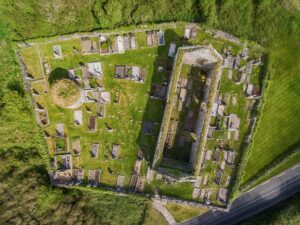
What makes it unusual is not its position, striking as that is, but a peculiarity in its lower masonry that caught the eye of the antiquarian Thomas Johnson Westropp on more than one visit in the early twentieth century. A cashel is a stone-walled ringfort, built without mortar, and thousands survive across Ireland. Most follow a fairly consistent building logic. This one does not, at least not entirely: beneath the main wall courses, Westropp found that rectangular crag blocks formed a base layer, and above them sat thinner header slabs placed upright, edge-on, in a row he compared to books standing on a shelf. He recorded this detail in 1913, returned to confirm it in 1915, and noted the arrangement was visible on the outer wall-face at the north side. It is a small anomaly, but one that has not been satisfactorily explained.
The cashel itself, known on the 1920 Ordnance Survey six-inch map as Caherclarig and on Robinson's 1977 map by the Irish form Cathair an Chláraigh, measures approximately 34 metres north to south and 30 metres east to west. Its double-faced dry-stone wall stood between 1.2 and 1.5 metres high in Westropp's time, though much gapped, and was around 1.8 metres thick. There was a lintelled gateway on the east side, and a hut enclosure within the interior to the south, the kind of small stone structure commonly found inside cashels and associated with early medieval occupation. By September 1997, when the site was inspected again, the encroaching hazel wood had made it effectively impenetrable, though surveyors could confirm the wall remained intact at the north-east, where it measured 1.6 metres wide and 1.4 metres high. Two upright posts were recorded within the wall fabric at the north-east, set 1.5 metres apart, and two small enclosures, each roughly 2.5 by 1.5 metres, were noted against the inner wall-face, though these appear to be later additions rather than original features.
The site had already been mapped as far back as the 1842 edition of the Ordnance Survey, hachured to indicate its earthwork form, suggesting it was recognisable in the landscape long before Westropp began his fieldwork. Whether it remains visible today, beneath the hazel growth, is another question entirely.