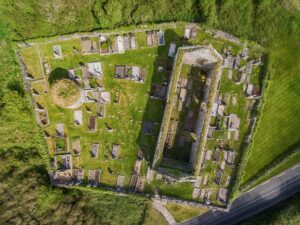
That ambiguity is itself part of the story. Mass-rocks are flat-topped stones, often natural outcrops, that served as improvised altars during the Penal era in Ireland, when Catholic worship was banned under laws that stripped Catholics of basic civil and religious rights. Priests celebrated Mass outdoors and in secret, frequently in remote or naturally sheltered spots, and the rocks used for those illicit liturgies were remembered long afterwards by local communities. The difficulty now is finding them.
This particular site in the Burren was recorded by the cartographer and writer Tim Robinson on his 1977 map of the area, one of the most detailed and celebrated attempts to document the Burren's dense layering of landscape, language, and human use. Robinson's maps are renowned for capturing precisely this kind of marginal, quietly significant detail. Yet when fieldworkers went looking for the mass-rock in 1999, they found nothing. They returned in 2007 and found nothing again. The cliff face, the hazel scrub, and the general terrain remain, but the rock itself, whether displaced, overgrown, or simply elusive, has not been confirmed on the ground. Nearby, two old enclosures survive within roughly 60 to 110 metres to the south and south-west, and a cave is marked on Robinson's map just north of the nearer of those enclosures. The broader landscape, in other words, carries clear signs of long human presence. The mass-rock, for now, is a dot on a map rather than a stone you can touch.