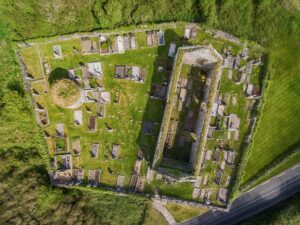
A cashel is a ringfort built from stone rather than earth and timber, and this one has held its shape remarkably well given its age. The outer wall-face, constructed from fairly regular uncoursed limestone blocks, remains generally intact, while the interior measures roughly 19 metres north to south and 18 metres east to west. The ground inside slopes gently eastward and is slightly rocky underfoot, typical of karst terrain where the bedrock lies close to the surface. Against the inner wall-face at the south-west, the remains of a hut site survive, suggesting that at least one small structure once occupied the enclosure's sheltered corner.
The site has been known to cartographers for well over a century and a half. It appears hachured on Ordnance Survey six-inch maps from both 1842 and 1920, meaning its outline was considered significant enough to mark across two separate survey editions. Despite that long cartographic record, it was listed only as an "Enclosure" in the Record of Monuments and Places in 1996, a cautious classification that understates what is clearly a well-defined cashel. The inner wall-face tells a more complicated story: though the outer face has weathered the centuries largely intact, the inner face survives only in patches and has been rebuilt in most sections, likely by later farmers who found the ready-cut stone useful for their own purposes. Field walls radiating outward from the cashel at the east-north-east, south-west, and north-north-west suggest the site was absorbed into an agricultural landscape at some point, its ancient boundary becoming the anchor point for a whole system of later enclosures. The best views from the hill extend from west to south-south-east, across the low Clare countryside.