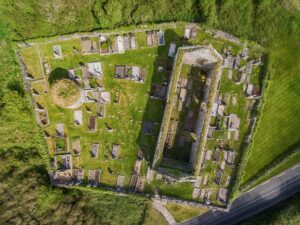
Farmers at some point laid a drystone field wall along the top of the original bank and, more intrusively, ran a field boundary straight across the structure at both the north-west and south-west, slicing through it as though the enclosure were simply an inconvenience to be divided up and used. The result is a site that reads as two things at once: an early medieval farmstead enclosure and a piece of working agricultural landscape that never quite stopped reshaping itself.
The enclosure is subcircular, measuring roughly 31 metres east to west and 29 metres north to south from crest to crest. Where the later drystone wall has not interfered, the original bank survives well, with an interior ground level that sits noticeably lower than the exterior, most pronounced on the eastern side where the bank stands about 1.1 metres above the interior. In the northern sector, three or four heavily overgrown mounds, each around five to six metres across and up to 1.5 metres high, are almost certainly the product of stone clearance rather than any ancient feature. The site appears on the Ordnance Survey 25-inch map of 1897 and again on the 6-inch edition of 1916, confirming it was a recognised feature in the landscape well into the modern era. A farm trackway still skirts it from east to south. About 50 metres to the south-south-east lies a wedge tomb, a type of megalithic monument typically dating to the late Neolithic or early Bronze Age, which means this modest cashel sits within a landscape that people have been organising, farming, and burying their dead in for several thousand years.