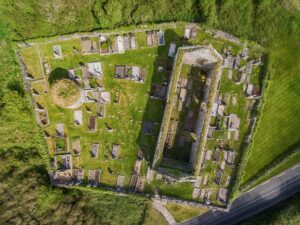
The garden itself is a large rectangular enclosure, roughly 275 metres east to west and 114 metres north to south, laid out on a south-facing slope immediately east of the castle. Its rubble wall, bonded with clay mortar and standing up to three metres in places, was never defensive in purpose; walled gardens of this kind were designed to retain heat, shelter crops, and signal the prosperity of the household within. Here, the wall narrows toward the top and has not survived in good condition, though enough remains to trace the full extent of what was once a considered and well-appointed space.
The detail preserved in the two Ordnance Survey editions of 1840 and 1916 is revealing. The northern edge of the garden carried a nine-metre-wide terrace, named the Turret Walk on both maps, defined by a low stone wall and taking its name from a circular decorative turret built at the north-east angle of the enclosure. The turret, which reaches a maximum height of 3.45 metres, has a string course running around its exterior 1.4 metres below the top, separating a parapet from the body of the tower, though no crenellations survive. About halfway along the north wall, a small stone structure projects outward, recorded as the Summer House on the 1916 map. Its exterior carries two brick-built statue niches and a single window of dressed limestone on the west wall, details that suggest some ambition in its finish. Inside the garden toward the south, a series of fish-ponds complete the picture of an estate landscape designed for both utility and display. The 1840 map also records an earlier road that ran along the north side of the garden before turning south toward the castle; the later road, taking a more direct line to the Corofin road, is the one that now bisects the garden, erasing the logic of the original approach entirely.