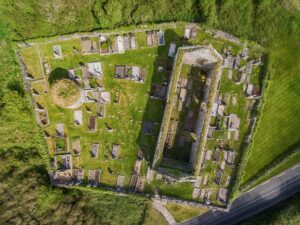
This is a cillin, the Irish term for an unconsecrated burial ground used historically for unbaptised infants and others denied burial in sanctified ground, and Parknahilly is a particularly spare example: trapezoidal in shape, no more than about fourteen and a half metres across its northern edge and just over twenty metres at its southern, with much of its perimeter simply open to the surrounding fields.
The site appears on the Ordnance Survey six-inch map of 1840, labelled plainly as a grave yard, and by the 1916 edition it had been recorded more specifically as a children's burial ground, shown as an unenclosed roughly rectangular area lying to the south of a field boundary. That boundary, a drystone wall, still defines the northern edge today. The southern extent is crossed by the foundations of a later field wall, and the eastern and western sides remain open, with a more recent north-south boundary visible just beyond the western limit. The burials themselves are marked only by uninscribed stones, and a number of these are no longer set into the ground, lying loose on the surface rather than standing upright. The cumulative effect is of a place that has been quietly absorbed back into the landscape, its function visible only if you already know what you are looking at.
The site sits on the floor of an east-west valley, in ordinary pasture, and there is nothing to signal its presence from any distance. The uninscribed stones are the thing to look for: small, unworked, and easy to mistake for field clearance if you are not expecting them.