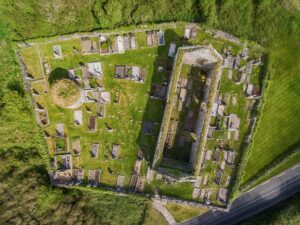
On two sides, the earthwork survives as a proper scarp, still reaching a metre in height at its most pronounced, but towards the north and south-southwest it fades entirely, absorbed into the ordinary contours of the field. What remains is enough to trace the shape: roughly 22 metres from northwest to southeast and 18 metres across the other axis, a subcircular enclosure that farmers and mapmakers have each, in their own way, quietly acknowledged.
Raths are the most common class of monument in the Irish countryside, earthen enclosures built during the early medieval period, typically between the fifth and twelfth centuries, and used as enclosed farmsteads by families of varying social standing. This one at Knocknareeha was recorded as early as the 1840 Ordnance Survey six-inch maps, where the conventional hachure marks denote an earthwork, and it appeared again on the 1916 edition. By 1996 it had been catalogued in the Record of Monuments and Places, listed somewhat cautiously as an enclosure. The caution is understandable: the site has been incorporated piecemeal into the field system around it. A stone wall now defines the northwestern arc where the original bank has gone, and a second wall cuts directly across the southwestern section of the interior, dividing what was once a single enclosed space. Roughly 100 metres to the west-northwest, a second rath sits in the same landscape, suggesting this was once a more populated agricultural area than the present empty pasture implies.