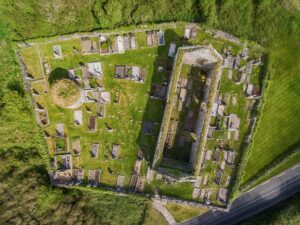
What makes this cashel, which is the term for a ringfort defined by a stone wall rather than an earthen bank or ditch, particularly worth attention is the natural bedrock step running north to south through its interior, raising the western half of the enclosed ground by some 1.6 metres above the rest. Whoever built here did not level the terrain; they worked around it, leaving a split-level interior that still reads clearly on the ground today.
The structure is subcircular in plan, measuring 46.4 metres north to south and 42 metres east to west, with a wall between 1.4 and 1.6 metres wide. When the antiquarian Thomas Johnson Westropp visited in 1905 and described it as a 'massive caher', the wall stood up to eight feet, roughly 2.4 metres, in places. It has settled somewhat since, though a four-metre stretch on the east side was rebuilt at some point and now reaches two metres in height again. The entrance, just 0.8 metres wide, opens at the south-south-east, on the upslope side of the enclosure, and a large stone on its western edge, 1.4 metres long and 0.9 metres high, remains in place. Inside, against the south-western wall, the collapsed remains of a drystone animal pen survive. The cashel was recorded on both the first edition Ordnance Survey six-inch map of 1842 and the later Cassini edition of 1920, marked with hachuring on each. More recently, a later house has been built directly over the wall at the north-east, one structure cannibalising the bones of a much older one.