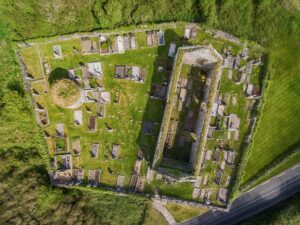
But what looks like a low, scrubby mound turns out to be a cashel, a type of ringfort defined by a stone perimeter rather than an earthen bank, its original form now so absorbed into the landscape that later farmers simply built a field wall on top of it and pressed on.
The enclosure at Carrownamaddra measures roughly 24 metres along its longer axis and sits on a gently northward-sloping hilltop with open views in that direction, the kind of elevated position that early medieval farmsteads in Ireland frequently favoured. It was already recorded on the first edition of the Ordnance Survey six-inch map in 1842, and was hachured, marked with short lines to indicate an earthwork, on the later twenty-five-inch plan of 1897 and again on the Cassini edition of the six-inch map in 1920. By 1996 it had been entered into the Record of Monuments and Places simply as an "Enclosure". The stone tumble that defines the northern, eastern, and south-western arc of the perimeter is low, between 0.4 and 0.6 metres high and up to three metres wide, and notably sparse in visible stonework. This has led to the interpretation that what survives may be the remnant of facing stones applied to an earthen bank rather than a freestanding stone wall, which would blur the usual distinction between a cashel and a more conventional earthen ringfort. Facing stones do survive on the outer edge of the tumble along the eastern and southern sections, and there is a slight berm, a narrow flat shelf, about three metres wide outside the perimeter on the east side.
From the south-west around to the north, the ancient perimeter has been overbuilt by a later double-faced field wall, roughly half a metre wide at its top and standing about 1.5 metres high, which bends westward at the western end. A livestock gap cut at the north suggests the enclosure has been in practical agricultural use for generations. The later wall almost certainly traces the older line, making the cashel, in effect, a foundation that subsequent farming absorbed without quite erasing.