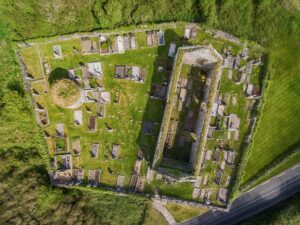
The Moravians, a Protestant denomination originating in Bohemia and Moravia whose communities were known for close-knit communal living and an unusually intense missionary culture, built their church here in 1793 to 1794. That they came at all to this corner of Clare is striking; that they were gone within two years makes the surviving wall feel less like a ruin and more like an interrupted sentence.
The congregation arrived at the invitation of a local family, and set to work constructing a building of some ambition for its setting. The north wall, which alone still stands, runs roughly west-northwest to east-southeast, stretches just over fourteen metres internally, and carries three wide arches separated by substantial piers. A single lintelled doorway, set within the central arch, is still legible. The south wall has collapsed entirely, leaving only a low earthen mound. By 1796, with political tensions across Ireland sharpening into what would become the 1798 Rebellion, the Moravians had departed. The brevity of their stay, barely three years from construction to abandonment, means the building never accumulated the ordinary sediment of parish life; it was simply left.
The wall sits on a knoll on a north-east facing slope, so the surviving stonework catches a particular quality of light from the east on a clear morning. A plaque in Irish was added to one of the piers in 1994, marking the two hundredth anniversary of the church's construction, which gives the otherwise empty structure an odd doubled quality: a commemoration of something that was itself barely commemorated before it ended.