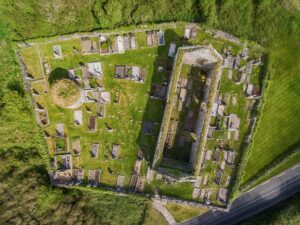
The name itself offers a small clue: the Irish word coill, meaning wood or woodland, appears in various anglicised forms across Clare placenames, and breedia may derive from a personal name or an older territorial marker, though without documented evidence it would be speculation to say more.
What can be said is that Kylebreedia exists within a county that is extraordinarily dense with prehistoric and early medieval remains, from megalithic tombs and ring forts to souterrains, which are stone-lined underground passages typically associated with early Irish settlement sites and used variously for storage or refuge. Clare's limestone landscape preserves such features with unusual persistence, which is part of why so many townlands in the region carry monument records at all. Liscullaun itself sits within this broader pattern of rural parishes where field boundaries, low earthworks, and overgrown enclosures can pass almost unnoticed by anyone not actively looking for them.
For now, Kylebreedia remains one of those places where the formal record exists but the substance behind it is not yet accessible to the general reader. Its classification as a monument means it was considered worth registering, which is itself a form of significance, even if the full story of what it is, what it was, and who left it behind has not yet been told in any public forum.