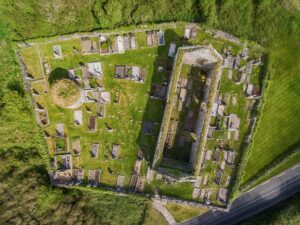
In Irish townland nomenclature, the prefix "Cill" almost always signals an early Christian foundation, a small church or monastic cell, often dating to the period between the fifth and twelfth centuries when Ireland's religious landscape was shaped by local saints and wandering clergy rather than the diocesan structures that came later. The second element likely preserves a personal name, possibly that of an otherwise unrecorded holy figure to whom the site was once dedicated. That dedication is now largely forgotten, but the enclosure itself remains: a roughly circular or oval boundary, the kind of feature that medieval ecclesiastical sites across Ireland share, marking off sacred ground from the ordinary world around it.
Ecclesiastical enclosures of this type, sometimes called "cillíní" in their smaller form or simply early church enclosures, were the defining unit of early Christian settlement in Ireland. The enclosing boundary, often a raised earthen bank, defined a sacred precinct that might contain a church building, a burial ground, and associated domestic or agricultural structures. In many cases the church itself has long since vanished, leaving only the circular outline in the landscape, detectable in aerial photography or as a subtle rise in a field. Kilvoydan sits in County Clare, a county with a dense concentration of such early medieval sites, reflecting the intensity of Christian activity in the region during the early historic period. Beyond what the place-name suggests and what the form of the monument implies, the specific history of this particular enclosure, its founding figure, its period of active use, and the fate of any structures within it, remains to be fully documented.