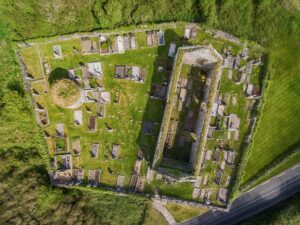
That gap itself says something. Ireland's countryside is dense with earthworks, a broad category that can cover everything from the raised banks of a ringfort, a circular enclosure used as a defended farmstead from the Iron Age through to the early medieval period, to the eroded traces of field boundaries, burial mounds, or enclosures whose original purpose has long since blurred into the ground. Carnaun's example is one of many that have been catalogued but not yet closely examined in any detail that has reached the public record.
The townland name Carnaun likely derives from the Irish "carn", meaning a cairn or heap of stones, a naming pattern common across Clare and suggestive of a landscape where ancient features were visible and memorable enough to shape local place names. County Clare as a whole is extraordinarily well supplied with earthworks of various kinds, many of them understudied, some surviving only as cropmarks or soil variations visible from the air. Without more specific information about this particular site, what can be said is that its formal recognition as a monument places it within a tradition of landscape features that communities have farmed around, built beside, and occasionally dismantled over centuries, often without any sense of what they were originally for.