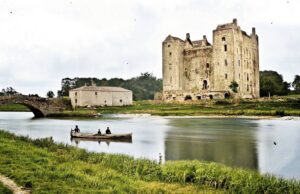
The tollhouse at Rossmanagher in County Clare took a different form entirely: two separate buildings, one positioned on each side of the road, with the toll gate itself strung between them across the carriageway. Any traveller passing through would have been funnelled between the two structures, framed on either side, with no easy way to slip past without paying.
The arrangement was put in place in 1847 by the D'Esterre family, who erected the pair of houses as a single functioning unit. The year is significant. Ireland in 1847 was at the worst point of the Great Famine, and yet investment in road infrastructure, however modest and privately motivated, was continuing in parts of the country. Toll roads, which required users to pay a fee at designated gates in exchange for using a maintained surface, had been a feature of Irish travel since the eighteenth century, administered variously by turnpike trusts and, as in this case, by private landowners with an interest in the roads crossing their estates. The D'Esterre family's decision to build two mirrored houses rather than one suggests both a degree of resources and a particular concern with controlling passage efficiently, perhaps reflecting the volume of traffic on this Clare road at the time.