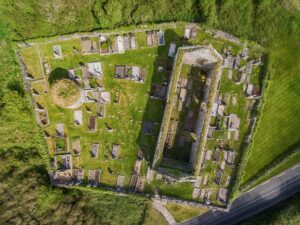
The very category it occupies, an architectural fragment, suggests something displaced or partial: a carved stone, a decorative element, a piece of worked masonry separated from whatever structure it once belonged to. Such fragments turn up across Ireland in fields, built into later walls, or propped against hedgerows, mute evidence of buildings that no longer exist in any recognisable form.
Cahercorcaun itself sits in a part of Clare with considerable archaeological depth. The name, derived from the Irish, suggests the presence of a caher, a type of stone-walled ringfort common in the west of Ireland, and the broader area carries the layered history typical of this region. Architectural fragments associated with such townlands can date from almost any period, from early medieval ecclesiastical carving to post-medieval decorative stonework, and without more specific detail it is difficult to place this particular piece in its proper context. What is clear is that someone, at some point, considered it significant enough to record formally, which is itself a small act of preservation against forgetting.
Given how little is currently documented in accessible form about this specific fragment, a visitor would have little to go on beyond the townland name. That uncertainty is, in its own way, part of the object's character. It exists at the edge of the known record, waiting for fuller description.