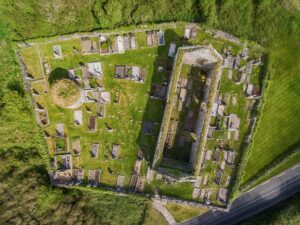
It measures just over eleven metres across and barely rises forty centimetres above the surrounding ground, which is precisely the point: what you are seeing is not so much a cairn as the ghost of one, a circular form that has lost most of its original stone material and now survives mainly as a silhouette pressed into the landscape.
A burial cairn of this type would originally have been a substantial heap of loose stone, built to cover and mark a prehistoric burial. The defining feature that survives here is the kerb, the ring of larger stones set upright around the base to retain the cairn material and define its edge. Nine kerbstones remain in place, ranging from half a metre to nearly two metres in length, arranged in clusters around the circuit. Three sit between east and south, two at west-southwest, and four between west and north. They are not all in their original positions: the easternmost has toppled outward, and two others lean in the same direction, suggesting the gradual collapse that follows once the mass of cairn material pressing against them from the inside is gone. The stones at the southwest, by contrast, sit flush with the interior, preserved more or less where they were set. At the centre of what remains, a cist has been exposed. A cist is a small box-like burial chamber formed from flat slabs of stone, typically containing human remains or grave goods, and its visibility here is itself a sign of how much the cairn above it has been disturbed or quarried away over the centuries.