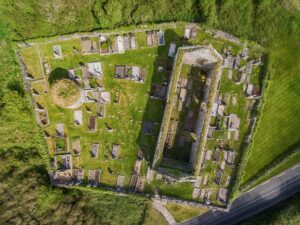
The cashel at Sheshodonnell, in County Clare, does the opposite. It sits in a slight hollow in rough pasture, with limited views outward in any direction, its defining wall so thoroughly collapsed that the outer face stones barely clear the ground, rising somewhere between ten and twenty-five centimetres at their most visible. The interior, roughly subcircular and measuring around twenty-five metres east to west and twenty metres north to south, is uneven and rocky underfoot. A modern animal pen occupies part of the northern edge. The whole thing has the quality of a place that has been quietly absorbed back into the working landscape.
A cashel is a ringfort defined by a stone wall rather than an earthen bank, a form particularly common across the limestone-rich west of Ireland. This example was legible enough in the late nineteenth century to be marked on the Ordnance Survey twenty-five-inch plan of 1897, and it appears again on the Cassini edition of the six-inch map from 1920, so its presence on the ground was recognised across several generations of surveyors. What those maps could not fully capture was the degree to which later agricultural activity had overlaid the earlier structure. A field wall, built at some point after the cashel fell out of use, now runs directly over the cashel's perimeter, making it genuinely difficult in places to distinguish the early medieval fabric from the more recent stonework. The site also sits within a wider, multi-period field system, suggesting that this particular patch of Clare countryside has been divided, worked, and reworked across a very long span of time.