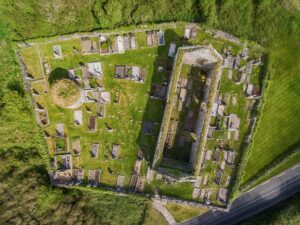
A cashel is a ringfort defined by a stone wall rather than an earthen bank, and this one sits on a south-facing slope in rough pasture, its circular enclosure measuring roughly twenty metres across its outer dimensions. The wall itself has largely collapsed, its double-faced stonework now a broad spread of tumbled material between four and eight metres wide in places, with only a modest height surviving on the exterior. Yet even in this reduced state, the site communicates something of its original organisation: a defined domestic space, built in stone, set into a sheltered hillside.
What makes the Poulaphuca cashel particularly interesting is how much activity surrounds it. Grass-covered field walls radiate outward from the enclosure to the east-northeast, southeast, and west, indicating that this was the focal point of a working agricultural landscape rather than a solitary structure. Within the interior, the slightly uneven ground conceals what may be a souterrain, an underground stone-lined passage or chamber often used for storage or refuge, as well as possible hut site remains along the inner edges, much of it buried beneath collapsed wall material. Two small alcoves are cut into the western inner wall-face, carefully proportioned niches whose precise purpose is unclear but whose deliberate construction suggests they served some practical or perhaps ritual function within the daily life of whoever occupied the cashel. Just outside the enclosure to the north-northwest sits a further hut site, and roughly fifty-seven metres to the southeast lies a fulacht fia, a type of prehistoric cooking site typically identified by a mound of fire-cracked stone beside a former water source or trough. Another hut site lies about a hundred and eight metres to the south-southwest. Together these features point to a multiperiod landscape, one that was settled, farmed, and returned to across different eras, with the cashel sitting at its centre.