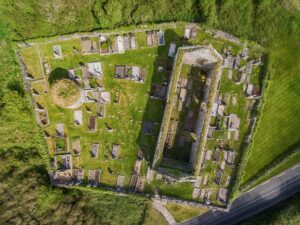
The relationship between the two structures is what gives the site its quiet interest: whoever built the hut was not working independently but was deliberately using the cashel as a ready-made shelter and boundary, pressing the dwelling right up against the enclosure's interior edge at its north-western arc.
A cashel is a stone-walled enclosure, typically of early medieval date in Ireland, used to define and protect a farmstead or settlement. This particular hut occupies the north-western portion of one such enclosure and measures roughly three metres east to west and just under three metres north to south internally, which makes it a modest space by any reckoning. The collapsed wall that now defines it survives to a height of only around half a metre and spreads to about a metre in width, the stones having slumped and spread over time into the familiar low ring that archaeologists recognise as the signature of a circular dry-stone structure gone to ruin. Whether the hut was a dwelling, a store, or some kind of ancillary outbuilding within the cashel's domestic economy is not something the physical remains alone can settle, but its deliberate placement against the cashel wall suggests a practical, space-conscious approach to building within an already-bounded enclosure.