They appear to have once formed part of an arch or doorway, the kind of shaped stonework that implies a threshold, an entrance, a building of some consequence. Where that building stood, nobody now knows.
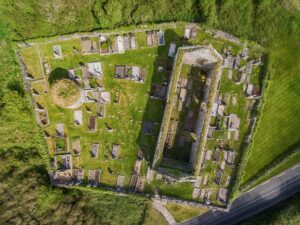
The church itself has found a second life as the Clare Heritage Centre museum, which gives the site an unusual doubled quality: a place of memory that has itself become a place for examining memory. The two stones are in the graveyard to its south, catalogued as architectural fragments from Laghtagoona. Dressed stone, meaning stone that has been cut and shaped by hand rather than left in its natural form, represents deliberate craft and suggests the original structure had some architectural ambition. An arch or doorway demands that kind of precision. But without any record of where the stones came from, they carry their purpose without carrying their history, which is an oddly common fate for displaced stonework in Ireland, where material was regularly robbed from older structures and moved to wherever it was needed.