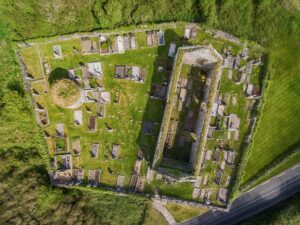
The enclosure at Parknabinnia is oval in shape, roughly 40 metres along its longer axis and 20 metres across, defined by walls made from very large stone slabs set upright on edge. It sits conjoined with a larger enclosure immediately to the east, and three further farm sites lie within 200 metres of it on the same hill, giving the impression not of an isolated monument but of a neighbourhood.
What makes this corner of the Burren particularly striking is the scale of what survives around it. Survey and excavation work, most extensively published by Jones and colleagues in 2011, has identified a prehistoric landscape stretching roughly 2.5 kilometres north to south and 1.5 kilometres east to west, incorporating farms, cairns, megalithic tombs, and extensive sections of prehistoric mound wall, all broadly contemporary with one another. The enclosure at Parknabinnia was partially excavated in 1995, and despite the limited scope of that work, the results were informative. Domestic artefact assemblages and radiocarbon dates taken from animal bone refuse placed the occupation of the farm in the Beaker period and the Early Bronze Age, a span roughly covering the late third and earlier second millennia BC. The Beaker period takes its name from a distinctive style of pottery found across Atlantic Europe at the time, and its presence here suggests this hillside farm was part of broader patterns of culture and agriculture reaching well beyond Ireland's western coast.