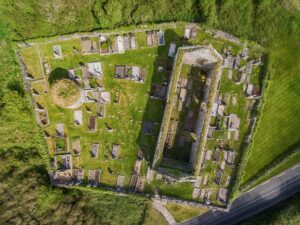
Most ancient enclosures survive in isolation, stripped of context by centuries of reuse and collapse. Here, the walls of the fields that once surrounded the farms have also survived, stretching approximately two and a half kilometres north to south and one and a half kilometres east to west, and the farms sit within them more or less as they were arranged when people last worked this ground.
The enclosure at Parknabinnia is one of three conjoined subcircular enclosures forming what researchers have designated Farm RH5. Subcircular in plan, it measures roughly 32 metres north to south and 54 metres east to west, and shares its walls with two neighbouring enclosures on the north-east and north-west sides. It belongs to a cluster of four such farm complexes on Roughan Hill, all lying within 200 metres of one another. Excavation at RH5 was limited, but the stone tools recovered were consistent with those found at the other farms on the hill, and the construction technique of the walls follows the same tradition as the broader mound wall field system enclosing the whole landscape. The Beaker period, named for a distinctive style of pottery found across Atlantic Europe during the late Neolithic and into the Early Bronze Age, is associated with early metalworking communities and settled agricultural life, and it is to this era that the enclosures at Roughan Hill appear to belong. The research drawing these connections was led by Jones and colleagues, published in 2011, and represents one of the more detailed reconstructions of a prehistoric farmed landscape anywhere in Ireland.