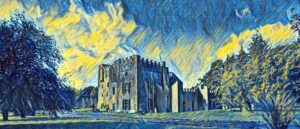
Nun's Island, in County Westmeath, takes its identity from an event in 1641, when the nuns of the Order of St. Clare abandoned their convent in the townland of Bethlehem, some seven kilometres to the north-east along the lakeshore, and sought refuge here from Cromwellian forces. The island already had a medieval church when they arrived, and it was to that existing structure they fled. According to a source cited in the nineteenth century, this temporary sanctuary gave the island the name it still holds.
The church ruin survives toward the northern end of the island, sitting within what appears to be an ecclesiastical enclosure, the kind of roughly circular or irregular walled precinct that early Irish monasteries and church sites were typically enclosed by. The boundary here is an irregular drystone wall, running approximately 96 metres north to south and 100 metres east to west, with sections still standing between half a metre and just over a metre in height, and a wall thickness reaching up to 3.5 metres in places. That width suggests something substantial was once intended. By 1976, a survey described the wall as roughly heart-shaped in plan, with later internal divisions, the whole mass much tumbled and overgrown. The enclosure appears on the 1837 edition of the Ordnance Survey six-inch map, recorded simply as an irregular field boundary, its ecclesiastical origins apparently unrecognised or at least unremarked at that point. The church itself, also heavily ivy-covered, retained at that same survey a single notable feature: a window dated to the twelfth or thirteenth century, described as fine but in a state of near collapse. Whether it has fared better or worse since is difficult to say. The island is now thickly wooded with scrub, which obscures the wall almost entirely and makes any close reading of the enclosure's shape or construction near impossible.