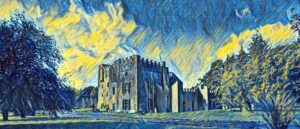
What makes it unusual is not its ruin but its legibility: the building has accumulated additions across roughly two centuries, and its bones still tell the story of each phase, from a compact Georgian core outward to later expansions that altered its footprint on three sides.
The earliest element is an 18th-century single pile house, a term for the simplest domestic form, a dwelling just one room deep, with rooms running in a single file rather than arranged around a more substantial plan. This original structure was aligned WSW-ENE, a two-bay block with walls 0.6 metres thick, and it appears on the 1837 edition of the Ordnance Survey six-inch map in something close to its original form. Inside, the arrangement is still readable: two rooms at each level, served by a central chimney stack with fireplaces opening on both faces at both storeys. On the ground floor, the eastern face of the stack held a notably large fireplace alongside what appears to have been a wall oven, suggesting this end of the house functioned as the kitchen. Higher up, a slit ope window, a narrow vertical opening typical of older construction, was cut into the east gable at first floor level and later filled in with brick, a small detail that marks the shift from one era's priorities to another's. A flat-headed doorway with roughly dressed voussoirs, the wedge-shaped stones that form an arch or lintel, survives in the centre of the east wall at ground level. Between the 19th and 20th centuries, the house was extended northward, southward, and eastward, wrapping around the original structure and complicating what had begun as something straightforwardly modest.
The setting adds its own dimension. The headland drops toward Lough Ree roughly 90 metres to the west, and the woodland that now surrounds the building would once have framed views across one of Ireland's largest lakes. The house did not begin as a grand statement; it began as a functional, well-made thing, and then grew, incrementally, into something more complex.