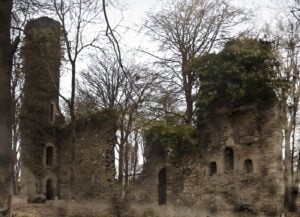
Beneath its wedge-shaped footprint, roughly 110 metres north to south and up to 100 metres east to west, lies the ghost of one of early medieval Ireland's significant monastic foundations, now legible mainly in the curve of surrounding roads and the presence of four high crosses among the headstones.
The monastery is associated with St. Aedan, also known as Moedoc or Mogue, who is thought to have established it before his death in 624. According to a nineteenth-century account by Shearman, the land was granted by a king named Brandubh, whom Aedan had supported in battle, a transaction that ties the foundation of a religious community directly to the politics of early Irish kingship. High crosses, the carved stone monuments produced by early Christian communities in Ireland, are among the most durable markers of monastic activity, and the four surviving examples here represent the principal physical evidence that a monastery once occupied this ground. A fragment of a graveslab, identified during work at the site in 2013, adds a further, quieter trace of that early presence.
What makes the site particularly interesting to look at with a map in hand is the possible scale of the original ecclesiastical enclosure. The curved line of the N11 Gorey road to the northwest and the road to the Harrow to the southwest may follow the arc of a boundary that once enclosed a space roughly 200 metres in diameter. If that reading is correct, the modern road layout has been quietly preserving the shape of a seventh-century monastic boundary for over thirteen centuries.