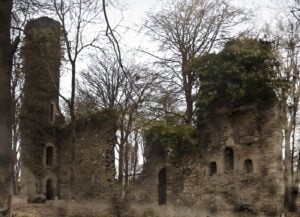
It is a fragment of a bullaun stone, a type of boulder or slab with one or more cup-shaped depressions ground into its surface. Bullauns are found across Ireland, often near early ecclesiastical sites, and their precise purpose remains genuinely uncertain. Some may have been used for grinding, others appear to have accumulated ritual or votive significance over time, with water collecting in their basins believed in folk tradition to carry curative properties.
The fragment at Clone measures roughly 0.7 metres by 0.5 metres and is only about 15 centimetres thick, suggesting what survives is a portion of a once larger stone. The single basin, around 25 centimetres in diameter, is partially preserved. It sits beside the church of Clone, a Romanesque structure, meaning it dates in style to the twelfth century, when that rounded-arch architectural tradition was being absorbed into Irish ecclesiastical building from continental Europe. The association of the bullaun with such a site is consistent with a pattern seen elsewhere in Ireland, where early Christian communities established themselves at locations that already carried local religious or ritual significance, and where older stones were retained within or beside the new sacred enclosure. The site is a National Monument in state ownership.