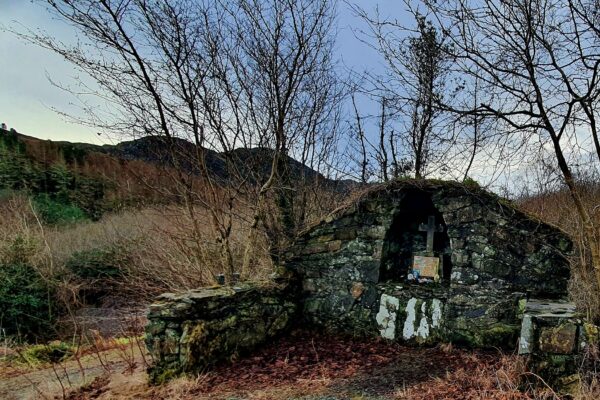
Ritual site - holy well, Mín An Bhealaigh, Conmhaigh, Co. Donegal
Co. Donegal |
Holy Sites & Wells
Tucked into the wet, rushy landscape of Mín An Bhealaigh in County Donegal, Tobersool holy well sits quietly beside a stream on sloping farmland.
The well itself is covered with flagstones, a traditional feature that both protected the water source and marked its significance to local communities. Like many Irish holy wells, this unassuming site has likely served as a place of ritual and reverence for centuries, though its exact origins remain unclear.
The well was documented during the Archaeological Survey of County Donegal, a comprehensive study conducted in 1983 that catalogued field antiquities from the Mesolithic period through to the 17th century. Holy wells such as Tobersool represent an intriguing blend of pre;Christian and Christian traditions in Ireland, where ancient water veneration practices were absorbed into Catholic devotional culture. These sites typically attracted pilgrims seeking cures for ailments or hoping to receive blessings, with specific wells becoming associated with particular saints or feast days.
Today, Tobersool stands as a modest reminder of Ireland's complex spiritual heritage. The flagstone covering and streamside location are characteristic of Donegal's rural holy wells, many of which continue to be visited by locals who maintain the old customs of leaving offerings, saying prayers, or performing ritual circuits around the site. While it may lack the grand architecture of more famous pilgrimage sites, Tobersool embodies the intimate, localised nature of Irish folk religion that persisted alongside formal church practices for generations.
Visitor Notes
Added by