
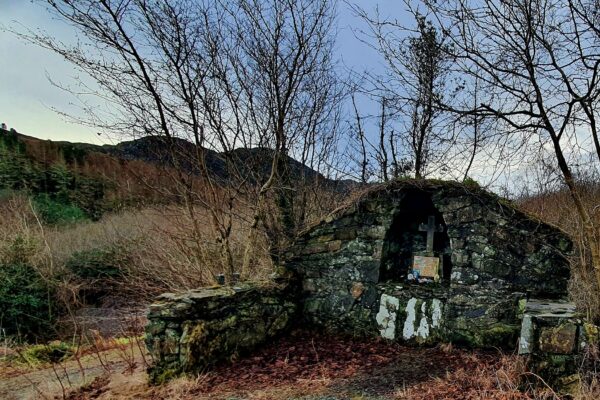
Bullaun stone, Doire Leac Chonaill Theas, Co. Donegal
Co. Donegal |
Holy Sites & Wells
Tucked away on the southwestern slope of a mound in Doire Leac Chonaill Theas, County Donegal, sits a modest yet intriguing piece of Ireland's religious heritage.
This portable basin stone, positioned near a well, features a carefully carved depression measuring 23 centimetres across and 9 centimetres deep. Known locally as a bullaun stone, it represents one of countless examples of these mysterious stone basins scattered across the Irish landscape, each one a tangible link to centuries of folk tradition and spiritual practice.
Bullaun stones like this one have served multiple purposes throughout Irish history, though their exact origins remain somewhat elusive. Some archaeologists suggest they began as prehistoric grinding stones for grain or herbs, whilst others propose they were always intended for ritual use. In Christian times, these hollowed stones became associated with holy wells and sacred sites, where rainwater collected in their basins was believed to possess healing properties. Pilgrims would visit such stones to cure ailments ranging from warts to headaches, often leaving small offerings or turning special cure stones within the depressions as part of their devotions.
The documentation of this particular stone forms part of the comprehensive Archaeological Survey of County Donegal, compiled in 1983 by Brian Lacey and his team of researchers. Their meticulous work catalogued field antiquities spanning from the Mesolithic period through to the 17th century, ensuring that even modest features like this bullaun stone were recorded for posterity. Whilst it may appear unremarkable at first glance, this weathered basin stone stands as a testament to the enduring blend of pre-Christian and Christian traditions that characterise so much of Ireland's archaeological landscape.
Ref: DG01473
04-Essential
Nearby Places
Visitor Notes
Added by
