
Clonamicklon Castle, Clonamicklon, Co. Tipperary South
Co. Tipperary |
Masonry Castles
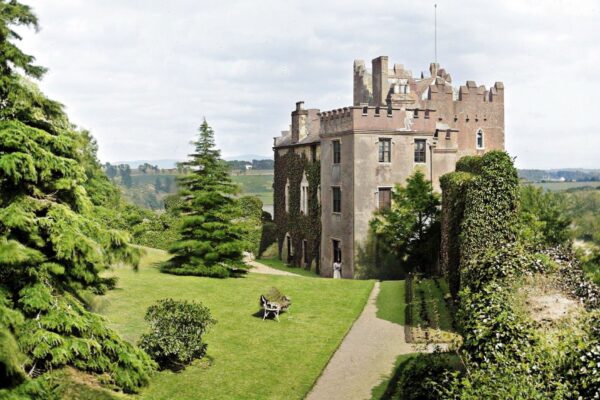
Standing on flat terrain with sweeping views north and west across the Tipperary countryside, Clonamicklon Castle is a remarkably well-preserved example of Anglo-Norman military architecture.
Built around 1306 by John Butler, son of the first Earl of Carrick, this limestone fortress represents one of Ireland's earlier masonry castles. The Slieveardagh hills dominate the southern and eastern horizons, providing a dramatic backdrop to this medieval stronghold that has witnessed over seven centuries of Irish history.
The castle's design reflects the defensive priorities of early 14th-century Ireland, with an almost square curtain wall measuring roughly 45 by 42 metres enclosing a substantial courtyard. Two angle towers punctuate the fortifications; a circular tower at the south corner and a D-shaped tower at the east, both rising three storeys high. The rectangular keep, positioned along the northwest curtain wall, stands as the castle's most imposing feature, originally containing multiple floors of living quarters complete with garderobes projecting from the walls on slate-like corbels. The gateway, once protected by a portcullis, leads through a gatehouse that features an elegant arrangement of round-headed arches, alternating between recesses and windows in classic medieval style.
What makes Clonamicklon particularly fascinating is how clearly it shows the evolution of Irish castle architecture across the centuries. The original 13th and 14th-century features, including straight-sided window embrasures with round arches and distinctive oeillet cross-loops for archers, remain alongside later modifications. During the 16th or early 17th century, likely when Pierce, Lord Viscount Ikeryn held the property, the castle underwent significant updates to make it more comfortable as a residence; mullioned windows replaced arrow slits, fireplaces were inserted for warmth, and a machicolation was added above the gateway for dropping unpleasant surprises on unwelcome visitors. The Civil Survey of 1654-6 described it as "a good castle, a slate house with a large bawne," testament to its continued importance as both a defensive structure and aristocratic home well into the early modern period.
Ref: TS00246
04-Essential
Nearby Places
Visitor Notes
Added by

Pete F
Simington, R.C. (ed.) 1931 The Civil survey, AD 1654-1656. Vol I: county of Tipperary: eastern and southern baronies. Dublin. Irish Manuscripts Commission.
Craig, M. and Garner, W. 1973 Preliminary report on buildings and sites of historic interest in Co. Sligo. An Foras Forbartha. Unpublished.