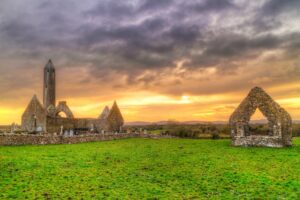
No stone, no mound, no depression in the ground marks the spot. The site of what is believed to be the tomb of the monastery's founding saint is, to all outward appearances, simply a field.
Kilmacduagh is one of the better-preserved early medieval monastic complexes in the west of Ireland, anchored by a leaning round tower and a cathedral that draw most of the attention. But tucked a short distance to the north of the round tower, and to the south-west of the cathedral, lay a small structure associated with Mac Duach himself, the sixth-century saint from whom the site takes its name. When the nineteenth-century antiquarians John O'Donovan and George Petrie were compiling their Ordnance Survey Letters in the 1830s, the building had already been destroyed, though O'Donovan noted that old men in the area could still remember seeing parts of it standing. Petrie went further, claiming to have been among those who saw the whole foundation, and he recorded its dimensions precisely: ten feet two inches long and five feet two inches wide, roughly three metres by one and a half. Whether this tiny structure was a chapel, a tomb, or both is a question that even those two meticulous observers could not quite settle. O'Donovan identified it as 'Temple Mac Duach', a church; Petrie was told it was the saint's tomb. The Ordnance Survey six-inch maps suggested they might be two distinct features, though they may simply have been recording the same confused memory from different angles.
Petrie sketched and measured what he found, and O'Donovan marked it as feature number seven on his annotated map of the site. Those records are now the only meaningful evidence that the structure existed at all. Nothing is visible at ground level today.