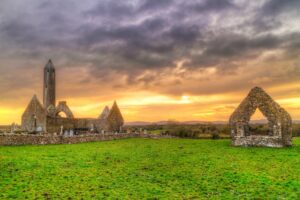
They rise from the ground, cast shadows at certain angles of light, and invite the eye to trace their outlines. The earthworks associated with the monastic complex at Kilmacduagh, in south County Galway, do almost none of this. They exist, in practical terms, as marks visible only from the air, spread across fields to the east, south, and west of the church known as Templemore. On the ground, a visitor would walk straight over them without knowing.
Kilmacduagh is a well-documented early medieval monastic site, associated with Saint Colman Mac Duagh and featuring one of Ireland's more dramatically leaning round towers. The earthworks in question were identified through aerial reconnaissance, and what the photographs revealed was not a tidy geometry but something harder to read: no discernible pattern, no obvious boundary or enclosure making itself plain. The one partial exception lies to the east, where a curving bank survives just enough to suggest it once formed part of an ecclesiastical enclosure, the kind of boundary, typically a raised bank or ditch, that defined the sacred precinct of an early Irish monastery, separating the spiritual and communal interior from the world outside. This particular curve is thought to relate to Templemurry, a church site in the vicinity. That a fragment of such a boundary can still be traced, however faintly, speaks to how layered this landscape remains beneath its ordinary agricultural surface.
The earthworks sit on land that shows little of this history to a casual eye, which is part of what makes the aerial evidence worth pausing over. What looks like unremarkable pasture turns out, from above, to carry the ghost of an organised religious landscape whose full shape has not yet been recovered.