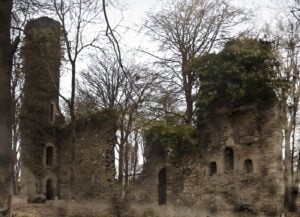
It was moved at some point to Ballyboy, roughly four and a half kilometres to the west, where it is now kept. That displacement is itself quietly telling: bullaun stones, which are boulders or slabs bearing one or more deliberately hollowed basins, have long attracted enough reverence or curiosity to make them worth shifting rather than abandoning.
The stone is oval, measuring 0.67 metres by 0.44 metres, and stands 0.33 metres high. Its single basin, scooped into the upper surface, measures 0.36 metres by 0.24 metres and reaches a depth of 0.12 metres. Bullaun basins were almost certainly used for grinding, though their repeated association with early ecclesiastical sites, holy wells, and graveyards has given them a secondary life in folk tradition, where the water pooling inside them was sometimes believed to have curative or cursing properties. What makes the Boolnadrum example slightly unusual is a small hole bored into the outer face of the stone, measuring four centimetres by two centimetres and only two centimetres deep. It does not connect to the basin, which rules out any functional drainage explanation, and its purpose is unclear. Whether it was made at the same time as the basin, or added later by a different hand with a different intention, is not recorded.