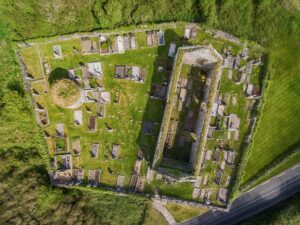
They appear as low, kidney-shaped or crescent mounds of fire-cracked stone and dark, charcoal-flecked earth, and the one at Ballykinnacorra in County Clare is a local example of this widespread but still not fully understood type of site. The basic mechanics are well established: stones were heated in a fire and then dropped into a water-filled trough to bring it rapidly to the boil, after which the spent, shattered stones were discarded to one side, accumulating over time into the distinctive mound. What remains debated is what exactly the boiling water was for. Cooking, brewing, textile processing, and bathing or sauna-like sweat houses have all been proposed, and the evidence across different excavated sites suggests that no single explanation fits every case.
Burnt mounds are generally dated to the Bronze Age, roughly 2000 to 500 BC, though some Irish examples have produced dates reaching into the Iron Age. They almost always appear near a water source, a stream, a spring, or a boggy hollow, which was both a practical necessity and perhaps a factor in where communities chose to gather for whatever activity the site supported. The Ballykinnacorra example sits within a county that has produced numerous such monuments, Clare's varied geology and hydrology providing the kind of waterside settings these sites seem to require. Beyond its location and monument type, the specific details of this particular mound, its dimensions, condition, and any associated finds, are not currently available in the public record.