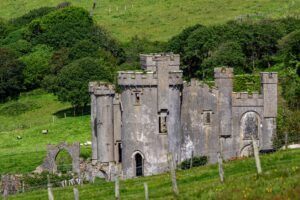
These structures belong to a tradition stretching back thousands of years across Ireland and Britain, raised during the Neolithic and Bronze Age periods as markers of territory, memory, or ritual. They are common enough on the Irish landscape that the eye can pass over them, mistaking them for natural outcrops or field clearance. This one, quietly occupying its place in Fakeeragh, is among those that have largely avoided the record.
The cairn form itself is worth pausing on. Unlike a passage tomb, which encloses a stone-built chamber accessible from outside, a simple burial cairn is often just what it appears to be: a deliberate accumulation of stone over a burial or series of burials, sometimes covering a cist, a small box-like grave lined with flat slabs. The labour involved was considerable, and the choice of location was rarely accidental. Prominent ridgelines, coastal promontories, and elevated ground were favoured, placing the dead in visible, commanding positions within the landscape. Whether the Fakeeragh cairn was positioned with any such intention, and what lies beneath it, remains unrecorded in any publicly available source at present.