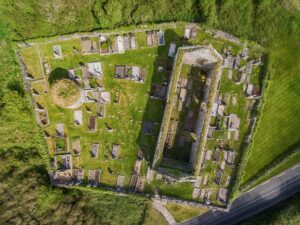
A cairn, in this context, is a mound of loose stones heaped over a prehistoric burial or used as a territorial or ritual marker, a form found widely across Ireland but varying considerably in scale and survival. This one measures roughly eight metres in diameter, modest by the standards of the great passage-tomb cairns of the west of Ireland, but notable for its position on a ridge aligned southwest to northeast through the karst landscape of the Burren.
What makes the spot quietly worth attention is not just the one cairn but the pair. A second cairn lies approximately sixty metres to the northeast along the same ridge, suggesting a deliberate, related arrangement rather than a single isolated monument. Such pairings are not uncommon in the prehistoric landscape of the Burren, where the exposed limestone plateau preserves an unusual density of ancient field systems, tombs, and enclosures. The disturbance visible at the Glenquin cairn is a familiar story across Irish prehistoric monuments, the result of stone-robbing, agricultural clearance, or informal excavation over centuries, none of which can be attributed to any specific event here.