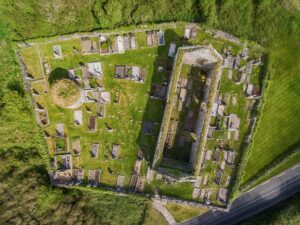
The mound is modest in every measurable sense, roughly 5.5 metres north to south, 5 metres east to west, and barely half a metre in height, yet it carries a formal classification as a cemetery cairn, meaning it was likely raised as a funerary monument in prehistory. What makes it quietly peculiar is not its scale but its behaviour: inspectors who visited the site in 1997 could not locate it at all, yet aerial photography taken between 2013 and 2018 shows it clearly enough. A feature that can vanish to the eye on the ground while remaining legible from the air says something about how thoroughly the landscape has swallowed it.
Paul Walsh and Tom Coffey, who examined and recorded the site, noted the possible presence of a kerbstone at the south-west, standing only about 0.2 metres high. Kerbstones are the upright or laid stones that define the outer edge of a cairn, giving it a boundary and a shape, and even a single surviving example suggests this mound was once a more deliberately constructed thing than its current grassy profile implies. More striking still, two cists were visible at the centre of the cairn. A cist is a small stone-lined box, usually set into the ground, used in prehistoric burial practice to hold a body or cremated remains. Their presence at the centre of the mound is consistent with the cemetery cairn designation, though how much of the original structure remains intact beneath the turf is unclear. The cairn sits within what is described as a large multiperiod field system, meaning the land around it has been divided, used, and reorganised repeatedly over a very long span of time. About 25 metres to the east lies an enclosure of some kind, and roughly 37 metres to the south stands a cashel, a type of stone-walled ringfort characteristic of early medieval Ireland. The cairn almost certainly predates both of these by a considerable margin, which gives the hilltop an accidental quality of compressed time, different eras of settlement coexisting in a small patch of pasture.