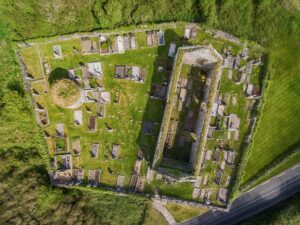
No headstones, no enclosure, no visible trace at ground level; just the tradition itself, passed down and noted, pointing to a patch of coarse uncleared land where something once happened that people chose to remember.
Places like this are known in Ireland as cillíní, informal burial grounds used historically for those who could not, under Catholic Church rules, be interred in consecrated ground. Unbaptised infants made up the majority of those laid here, though suicides, strangers, and others deemed outside the parish community were sometimes buried in such spots too. The absence of headstones at Booltiaghadine is not unusual; many cillíní were marked only by small stones, if at all, and in overgrown or marginal ground those markers disappear quickly. When the site was inspected in 1999, nothing was visible at ground level, and the burial ground survives now as local memory more than physical monument. What gives the location an additional layer of interest is its proximity to a ring barrow, a circular earthen mound of prehistoric funerary origin, which lies roughly 66 metres to the north-north-west. The convergence is unlikely to be coincidence. Cillíní were frequently placed at the edges of older, liminal spaces, pre-Christian burial sites, townland boundaries, or the margins of cultivated ground, where the unconsecrated dead could rest somewhere already understood as a place set apart.