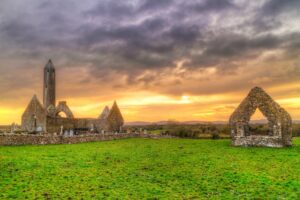
A field boundary cuts straight through the middle of it, running west-northwest to east-southeast, dividing the site as if the land simply forgot what it once was. These places, known in Irish as cillíní, were used for centuries across Ireland to inter infants who died before baptism, since Church law denied them burial in consecrated ground. Quietly maintained at the edges of farms and townlands, they occupy a peculiar position in the Irish landscape, neither fully forgotten nor formally remembered.
The site at Roo follows a pattern familiar from similar burial grounds elsewhere in Connacht. Its roughly subcircular form is a common feature of cillíní, many of which reused earlier enclosures or simply accumulated use over generations without formal planning. A second field wall running roughly north to south defines the western limit of the southern section. North of the bisecting boundary, only one or two grave-markers remain visible at the surface; the rest has been absorbed into the working landscape. The southern portion is dense with trees and scrub, the south-southeast sector having been entirely impenetrable due to thick overgrowth at the time the site was surveyed.
The overgrowth that now makes part of the site inaccessible is itself part of the story. Many cillíní were deliberately planted with whitethorn or left to naturalise, partly out of a sense that the ground was neither fully of the church nor fully of the everyday world. What a visitor would find at Roo today is less a legible burial ground than a set of boundaries, walls, and encroaching vegetation, with a grave-marker or two emerging from the grass to the north. The site asks more of the imagination than of the eye.