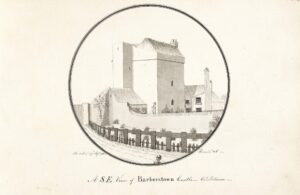
In an open field in County Kildare, a graveyard without a fence marks the site of a church that has been sinking quietly into the ground for centuries. What remains is not a ruin in the conventional sense, not tumbled walls or a roofless shell, but a series of low grassed-over ridges in the soil: the faint external outline of a rectangular structure some 25 metres long, barely 20 centimetres proud of the ground on the interior, with a slight rise where a north-to-south internal wall once divided the nave from the chancel. The place still appeared on Taylor's 1783 Map of County Kildare, which suggests it retained at least some presence above ground at that point, but by the time anyone thought to record it carefully, the walls were already level with the earth.
The site carries a name that pulls back much further than any standing masonry. Castledillon was originally known as Diseart Iollathan, meaning St. Illan's Hermitage, a diseart being an early Irish monastic retreat, typically modest in scale and often associated with a single founding figure. St. Illan was a Celtic saint venerated on the 2nd of February. Around 1200, a grant recorded by Ronan transferred the site to St. Thomas's Abbey, and it later passed to St. Wolstan's, a priory near Celbridge. A 1294 ecclesiastical report listed the church of Tristledelan, a later corruption of the original name, alongside the church at Killadoon as being not worth the service of chaplains, a blunt administrative verdict that hints at a community already in decline. By 1615, the site was recorded as ruinous. Within what may have been the boundary of an early ecclesiastical enclosure, the church foundations share the ground with a graveyard, a possible children's burial ground, and the original location of the Castledillon Stone, a fine 13th-century carved effigy that has since been moved elsewhere.