That connection alone would make the local church worth a second glance, but the building itself quietly rewards closer attention. What looks at first like a Victorian Church of Ireland nave turns out to be grafted onto a medieval tower that has been standing here, in one form or another, since at least the thirteenth century.
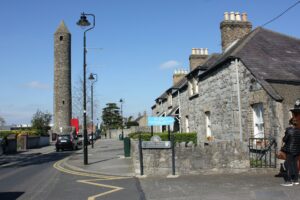
The historical record reaches back even further. The Book of Howth records a chapel on this site founded in 519 A.D., supposedly linked to Isolde herself, though the first documentary evidence of a functioning church comes from 1228, when King Henry III granted the advowson, that is, the right to nominate a clergyman to the living, to the prior of the Order of St John of Jerusalem at Kilmainham. After the Dissolution of the monasteries, the church passed through a succession of lay owners, and by 1597 the College of the Holy Trinity had acquired some of its possessions. The Civil Survey of the mid-seventeenth century found it in a reduced state, describing it as a "chaple in repayre." The nave extending eastward from the tower dates to 1859, but the tower itself is medieval: four storeys of coursed rubble masonry with dressed quoins, corner piers, and crenellations at the top. Its interior dimensions measure 4.2 metres square, with walls 0.70 metres thick. Slit windows light the lower storeys; paired round-headed lancets open at belfry level; and a projecting stair turret climbs the exterior. Inside the church, two seventeenth-century mural tablets survive, one commemorating Henry and Elizabeth Hierome, the other Gyles Curwen, his wife Luci, and two grandchildren who died in infancy. Excavations at St Martin's Row in 1992 revealed that the medieval graveyard once extended beyond the present boundary wall, with burials predating a ditch that pottery evidence places in the thirteenth or fourteenth century.
Chapelizod village sits just off the main road running along the Liffey toward the Phoenix Park, and the Church of St Lawrence is straightforward to find on foot or by bus from the city centre. The tower's west face, with its tracery windows set within segmental arches, is visible from the approach. The entrance on the south front, framed by a Tudor arch with hood moulding and reached by six steps, leads into the later nave rather than the tower directly. As a Church of Ireland building in active use, access to the interior is typically possible during services or open days, and it is worth checking locally before visiting if seeing the seventeenth-century tablets is the goal.