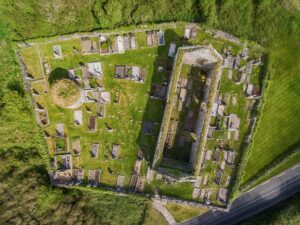
Set in the Burren's southern reaches, the site is perhaps best known among those interested in medieval ecclesiastical carving for the sheela-na-gig fixed above its doorway. A sheela-na-gig is a carved stone figure, typically female and explicitly sexual in pose, found on a number of Irish and British churches and castles from the medieval period; their precise purpose remains a matter of genuine scholarly debate, with interpretations ranging from fertility symbols to moral warnings. The one at Killinaboy is among the better-preserved examples in Ireland, and its presence on a church wall is precisely the kind of quiet contradiction that makes early medieval Irish Christianity so endlessly interesting.
The church itself is associated with the parish of Killinaboy, the name deriving from the Irish Cill Inghine Baoith, meaning the church of the daughter of Baoth, suggesting a foundation connected to an early female saint. The building visible today is largely medieval in date, with later phases of construction and repair evident in the fabric of the walls. A double-armed cross, sometimes called a patriarchal cross or cross of Lorraine, is carved above the west doorway alongside the sheela-na-gig, a pairing that gives the entrance an unusually layered character. The surrounding graveyard remains in use, which is common in rural Ireland and means the site has been continuously tended even as the church itself fell into ruin.