
Cloghastookeen Castle, Cloghastookeen, Co. Galway
Co. Galway |
Masonry Castles
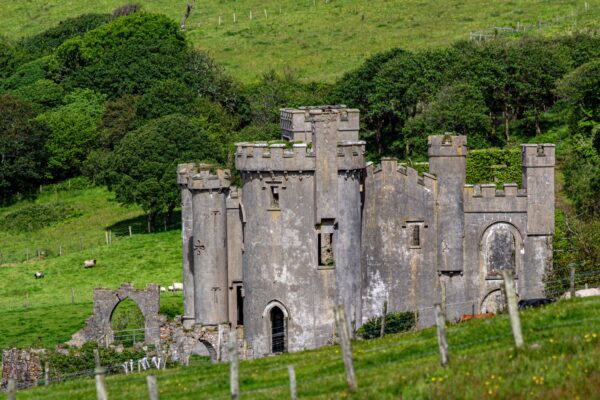
Within the southeast corner of an ancient cashel enclosure in Cloghastookeen, County Galway, stand the weathered remains of what was once a formidable tower house.
Records from 1574 reveal that the castle belonged to one Hubt McEdmud McUllig, placing it firmly within the tumultuous period of Gaelic and Anglo-Norman power struggles that characterised medieval Ireland. Today, visitors will find little more than an irregular mound of stones, though careful observation reveals fascinating architectural details that speak to its former grandeur.
The most striking surviving feature is a pointed arch doorway on the northern side, facing east; a classic element of medieval Irish architecture that would have served as the castle's main entrance. On the south-southeast side, remnants of a fireplace face westward, offering a glimpse into the domestic arrangements of the tower house. These architectural fragments, though modest, provide tangible connections to the daily lives of those who inhabited this fortification over four centuries ago.
The castle's location within a cashel, a type of ring fort typically associated with earlier Irish settlements, suggests a continuity of occupation spanning several historical periods. This layering of defensive structures was common throughout Galway, where successive generations adapted and rebuilt upon ancient foundations to suit their needs. Archaeological surveys conducted by University College Galway continue to document sites like Cloghastookeen, ensuring that even the most ruined castles contribute to our understanding of Ireland's complex medieval landscape.
Ref: GA05719
04-Essential
Nearby Places
Visitor Notes
Added by

Pete F
O’Flanagan, Rev. M. (Compiler) 1927 Letters containing information relative to the antiquities of the county of Galway collected during the progress of the Ordnance Survey in 1839. Typescript in 3 vols. Bray.
Nolan, J.P. 1901a Galway castles and owners in 1574. Journal of the Galway Archaeological and Historical Society 1, 109-23.