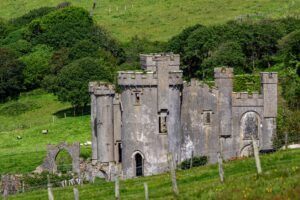
Among the civic buildings he caused to be erected was a court house, the kind of structure that announced a town's seriousness of purpose: a place where law was administered, disputes settled, and the machinery of colonial governance made visible in stone. Court houses of this period in the west of Ireland tended to follow a fairly standard pattern, drawing on the austere classical vocabulary favoured by the Board of Works, with modest porticos or pedimented facades signalling authority to a largely rural population for whom such architecture was both unfamiliar and deliberately imposing.
Clifden itself was an unusual experiment. Founded on boggy ground at the head of a sea inlet in one of the most remote corners of Galway, it was laid out with streets, a market, and public buildings at a time when much of the surrounding landscape supported only scattered rural settlement. The court house would have been central to that project of civic institution-building, serving a hinterland that stretched deep into Connemara. The town survived the catastrophe of the Great Famine, though the wider region was devastated, and the D'Arcy estate eventually collapsed under the weight of debt and the years of crisis. What remained was the town itself, its grid of streets and its stone buildings carrying the outline of an ambition that was only partially realised.