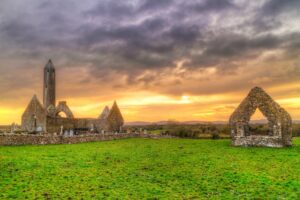
No trace of it survives above ground today, and even its species is disputed, but it was venerated within the monastic complex at Kilmacduagh to a degree that placed it alongside the site's more obviously monumental remains: its round tower, its ruined churches, its bishop's house.
The antiquarian John O'Donovan, writing in the Ordnance Survey Letters in the nineteenth century, described it as an ash tree held in great veneration, noting that people carried small pieces of the wood about as preservatives against accidents. He located it a short distance to the north-west of the cathedral and recorded that it had been built up in a stone cloidhe, meaning a ditch or earthen boundary, a detail that suggests it was deliberately enclosed or marked out rather than simply growing wild at the edge of the complex. O'Donovan even included it on a site plan, numbered among the significant features. Writing in 1893, however, the historian Fahey referred to it not as an ash but as a yew tree, and placed it to the west of the cathedral rather than the north-west. The Ordnance Survey six-inch maps add a third position, placing it approximately sixty-five metres to the south-west of the building. Three sources, three different locations, and no surviving physical evidence to settle the matter.
The disagreement over both species and position is itself revealing. Sacred trees associated with early Irish monastic and ecclesiastical sites were a recognised feature of the landscape, often linked to a founding saint, and their wood was sometimes treated as a relic in practical, everyday terms rather than in any formal liturgical sense. At Kilmacduagh, founded in association with Saint Colman Mac Duagh, the tree appears to have functioned in exactly that way. What remains is not the tree, nor its stump, nor even a clear consensus on where it stood, only the written record of what it once meant to the people who gathered pieces of it and kept them close.