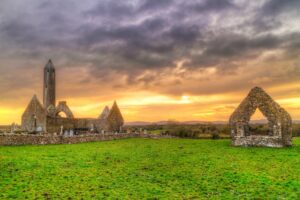
The enclosure itself is easy to miss: a subcircular earthen bank, now worn down to a maximum height of around 0.4 metres and a width of roughly 3.8 metres, curving around the church known as Templemurry and possibly also around the cathedral and the famously leaning round tower beyond it. At its widest the enclosed space stretched more than 67 metres east to west and around 62 metres north to south, making it a substantial territorial boundary in its day, even if the ground now gives little sense of that scale.
Ecclesiastical enclosures of this kind, sometimes called a monastic vallum, were the defining spatial feature of early Irish monasteries. They marked the boundary between sacred and secular space, and their layout often determined how a monastic settlement grew over subsequent centuries. At Kilmacduagh, associated with the sixth-century saint Colmán mac Duagh, the complex grew to include a cathedral, multiple smaller churches, a round tower, and other structures, all of which developed within or immediately around this original boundary. The enclosure survives best from the eastern to south-eastern arc. To the west, where the road cuts through, no clear trace of the bank remains, though the curving southern wall of the graveyard that surrounds the cathedral may preserve a memory of where the enclosure once ran, the later boundary quietly following the ghost of the earlier one.
For anyone visiting the site, it is worth walking the graveyard's southern perimeter and looking back towards Templemurry with the road between them. The slight rise and curve of the ground to the east, easy to dismiss as uneven pasture, is where the bank is most legible. The enclosure carries a preservation order under the National Monuments Acts, which means the ground within its footprint is protected even where nothing visible survives above it.