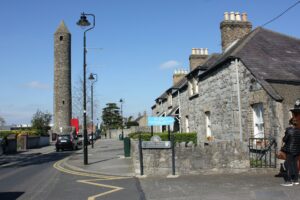
The curving line of Orchard Lane and its southward continuation, meeting Main Street as far as the junction with Boot Road, preserves the eastern arc of an early monastic enclosure, the kind of circular boundary, known in Irish archaeology as a monastic vallum, that once defined a community's sacred and working space. Walk that curve today and you are, in effect, walking the perimeter of a foundation that was already considered significant enough to plunder in 833 AD.
The monastery was founded in the seventh century by a saint known variously as Crónán, Mochua, and Macotus, whose feast day fell on the 6th of August. According to the scholar Ó Riain, he was the best-known of seven sons of Lughaidh son of Nathí, of the Uí Chéithigh, a Leinster family whose name survives in the Kildare barony of Ikeathy. His mother, Cainnear, was attached to the church at what is now Clonsilla in County Dublin. The monastery he founded here, at a place called Chluain Dolcáin, meaning Dolcán's Meadow, had close connections with Glendalough; the Life of St Kevin records that it was Crónán who baptised Kevin himself. By 789, the relics of Mochua had been formally translated to Clondalkin, a sign of the site's ecclesiastical standing. The Vikings raided it in 833, and the place afterwards became a base for Viking activity in the area. Olaf the White, the first Norwegian king of Dublin, established a fort here, recorded only once in the annals, when it was attacked and burned in 867 by two Leinster chieftains. Where exactly that fort stood is unknown; it may have occupied the monastery itself, as Vikings appear to have done at sites such as Monasterboice and St Mullin's, or it may have been nearby, perhaps in the area suggested by the placename Raheen. The monastery burned again in 1071, and by 1077 a dispute over the abbacy had resulted in its passing to the Célí Dé, a reform movement within the Irish church. Before the Anglo-Norman invasion, its lands had been absorbed into the diocese of Dublin, a reorganisation that followed the Synods of Rath Breasail in 1111 and Kells in 1152.
The round tower still stands at the centre of what would have been the enclosure, and the early church site remains identifiable on the ground. The monastic enclosure itself is a designated archaeological monument. For those interested in the documentary traces of the site, Trinity College Dublin holds a fifteenth-century manuscript known as the Clondalkin Breviary, which contains a medieval Irish chant from the Matins Office of Saint Brigid; a recording is available online. The curving streetscape is best appreciated on foot, moving slowly between Orchard Lane and Main Street, with an eye to the way the modern town has been quietly shaped by boundaries that are over a thousand years old.