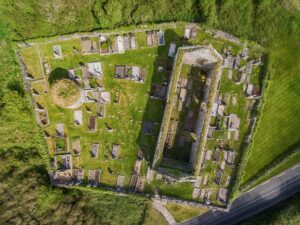
What was once a substantial ringed structure, known as Caheroisin or Caheraoisin, a caher being a stone-walled enclosure of early medieval origin, has been so thoroughly absorbed into the working landscape that most of its original fabric now forms part of an ordinary field boundary. The outline survives not as a monument you could easily walk around, but as a low scarp and a scatter of incorporated stonework that only reveals its full circuit when viewed in aerial imagery.
The antiquarian Thomas Johnson Westropp recorded the site in 1896, noting that the fort was defined by an enclosing element of earth and stone and that it retained identifiable entrances, or gates, at both the east and the west. He also observed an old road approaching the western entrance, a detail confirmed by the first edition Ordnance Survey six-inch map of 1842 and the later twenty-five-inch plan of 1897, both of which mark a track running northwest from the western edge of the enclosure. When the site was inspected in 1999, the upstanding remains survived only along the northeastern to southwestern arc, where a drystone wall roughly half a metre wide and up to a metre high on the exterior face had been built incorporating the original enclosing element. A short stretch of the original outer wall-face, standing to about a metre, survived at the south, alongside a moss-covered stony bank between the southeast and south. Much of the southern perimeter was overlaid with scrub-covered spoil, and a four-metre gap at the south was blocked with overgrowth and timber debris. The rest of the circuit, from the south-southwest around through the west to the north, had been levelled almost entirely flat, leaving only a faint scarp to mark where the boundary once ran.
The faint trace of the old access track that Westropp observed is still faintly visible in satellite imagery, a remnant of a routeway that once led people deliberately toward a western gate that no longer stands. The interior of the enclosure is largely level ground, though it slopes away toward the north, and the complete circuit of the monument, invisible to anyone simply crossing the field, can be traced as a continuous low earthwork when seen from above.