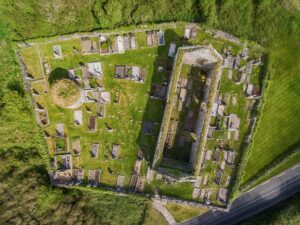
What makes it quietly arresting is not its size, though at roughly 42 metres by 29 metres it is substantial, but the combination of things happening within and around it: a cliff drop of about five metres lies only fifteen metres to the north-west, the enclosure shares a wall with a neighbouring structure to the east, and tucked into its south-eastern corner is a souterrain, an underground passage or chamber of the kind commonly associated with early medieval settlement in Ireland, often used for storage or as a place of refuge.
The enclosure is defined differently on each side, which gives some sense of its layered history. The northern and western boundaries are formed by a relatively modern drystone wall standing about 1.3 metres high, while the southern side has largely collapsed into a wide spread of stone rubble, up to 4.5 metres across. The eastern wall is the most coherent, measuring 1.2 metres wide with additional collapse bringing the combined spread to around three metres; this is the wall shared with the adjoining enclosure, suggesting the two structures were either built together or developed in close relation to one another over time. The hazel growth that now obscures much of the interior and the southern and western walls makes it easy to miss the underlying complexity of the site.
The plateau setting means the enclosure commands wide views westward and around to the north-east, which would have made it a practical as well as defensible position for whoever built and used it. The souterrain in the south-eastern sector is a reminder that what looks from the outside like a simple field boundary is almost certainly the remains of something more organised, a settlement or enclosure with structures and functions that the surface alone cannot fully reveal.